Can Science End War by Everett Carl Dolman
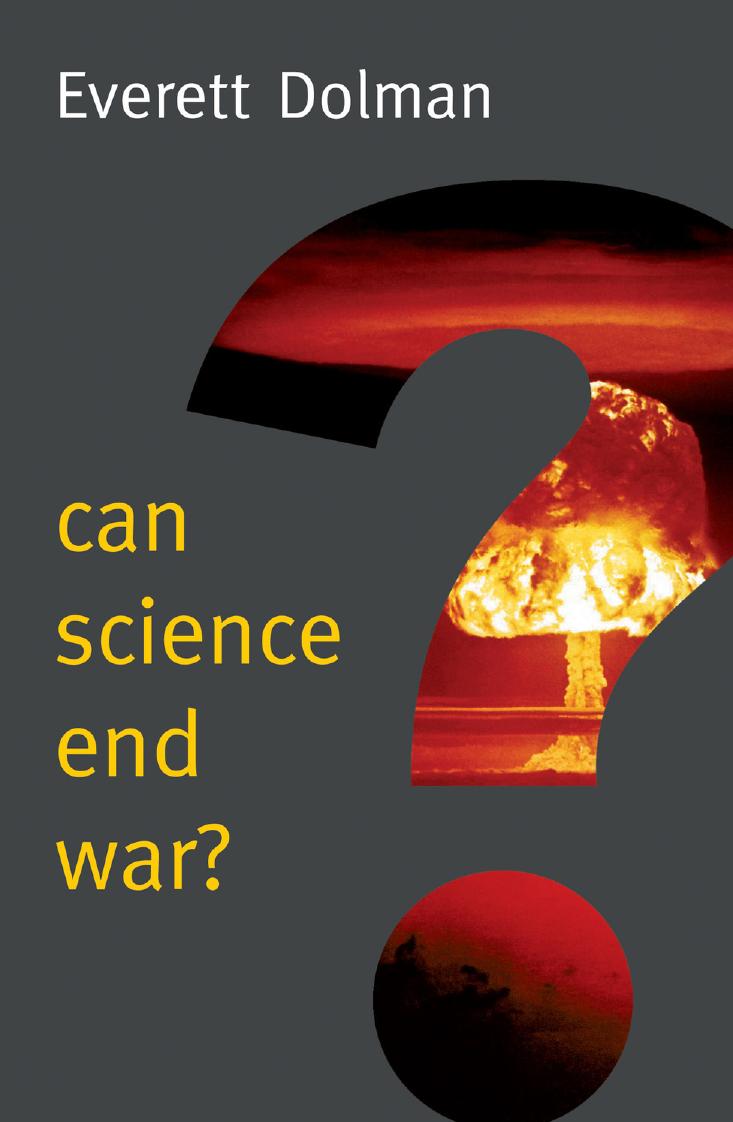
Author:Everett Carl Dolman
Language: eng
Format: epub, pdf
Publisher: Wiley
Published: 2015-11-26T16:00:00+00:00
Some possibly frightening examples of non-lethal weapons
Sight weapons
Sight weapons are intended to limit the ability of the enemy to see and evaluate the course of battle, and thus to induce errors in deployment or other decision making. As such, traditional visually obscuring techniques such as introducing fog or smoke into the battlespace are now considered classic non-lethal sight weapons.
The primary effort today is to develop temporarily blinding lasers (Hecht 2012), the problem being that not all people react to light stimulus the same way (what temporarily blinds one may permanently blind another). These are some of the simplest non-lethal weapons available today. After classroom laser pointers became ubiquitous, numerous reports from airline pilots being lasered by what appear to be individuals out for a prank illustrate the safety problems that can result when unthinking individuals play around with high-tech gizmos. Blinding the operator of an opposing weapons system may not make that person stop shooting, however, though it will definitely hurt his or her aim (which is not good for the effort to limit collateral damage). If the opponent is operating a vehicle of any sort, he or she may not be able to avoid crashing into something or someone, a possibly undesirable intent of such an action. With more powerful lasers – and these are available commercially as well as in restricted defense laboratories – the victim could be permanently blinded. From a harsh military perspective, permanently incapacitating the enemy's troops may put a heavier burden on them than simply killing them, and could be justified as militarily expedient. The enemy must still care for its wounded, with no hope they will return to battle, draining resources that might otherwise be available for active combatants: “a dead soldier is just dead, but a blinded one needs the help of others, thus tying up several enemy soldiers at once – similar to the thinking behind the use of landmines to blow off legs and arms” (Drollette 2014).
Blinding is the most obvious use of directed energy in an anti-personnel role, but numerous other capabilities exist. An alternative visual weapon design is to produce strobe effects that could induce epileptic convulsions in those predisposed to them, but at least headaches and other temporary distractions ranging from disrupted decision making up to effective paralysis for the rest. The opponent is tired, increasingly irritable, and gradually demoralized as sleep deprivation takes its additional toll. When quicker results are needed, the same logic informs the use of flash-bang grenades by military and police Special Weapons and Tactics (SWAT) teams. These produce an intentionally blinding burst of light along with an ear-splitting noise to disorient and confuse belligerents in a hostage situation. Physical harm can come to an opponent who is too close to the grenade when it goes off, though vastly less so than a concussion- or shrapnel-producing grenade.
The big issue for sight weapons is that the amount of energy necessary to temporarily blind an individual is dependent upon the target's sensitivity, distance, whether the
Download
This site does not store any files on its server. We only index and link to content provided by other sites. Please contact the content providers to delete copyright contents if any and email us, we'll remove relevant links or contents immediately.
Whiskies Galore by Ian Buxton(42025)
Introduction to Aircraft Design (Cambridge Aerospace Series) by John P. Fielding(33135)
Small Unmanned Fixed-wing Aircraft Design by Andrew J. Keane Andras Sobester James P. Scanlan & András Sóbester & James P. Scanlan(32808)
Aircraft Design of WWII: A Sketchbook by Lockheed Aircraft Corporation(32299)
Craft Beer for the Homebrewer by Michael Agnew(18251)
Turbulence by E. J. Noyes(8059)
The Complete Stick Figure Physics Tutorials by Allen Sarah(7382)
The Institute by Stephen King(7051)
The Thirst by Nesbo Jo(6957)
Kaplan MCAT General Chemistry Review by Kaplan(6941)
Bad Blood by John Carreyrou(6628)
Modelling of Convective Heat and Mass Transfer in Rotating Flows by Igor V. Shevchuk(6458)
Learning SQL by Alan Beaulieu(6298)
Weapons of Math Destruction by Cathy O'Neil(6290)
Man-made Catastrophes and Risk Information Concealment by Dmitry Chernov & Didier Sornette(6032)
Permanent Record by Edward Snowden(5853)
Digital Minimalism by Cal Newport;(5773)
Life 3.0: Being Human in the Age of Artificial Intelligence by Tegmark Max(5563)
iGen by Jean M. Twenge(5422)
